
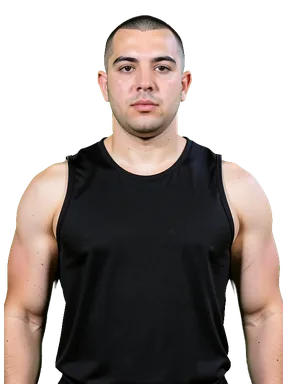
Emrah
Arda
Centre
Academy: Fıstıkçılar Gaziantep

Academy: Fıstıkçılar Gaziantep
Free agent
18 years · 214 cm · 128 kg · Türkiye
 Türkiye
At a glance



What is Stars?
Stars
The grade your scouts give him out of five, for his ability now and for his potential. Half a star is ten rating points. Solid stars are what your scouts know; light blue stars are how far they might be out.
Nothing on its own. The stars are read from the same number or band printed beside them, so they never say more than it does.
Scout him. A narrower range turns light blue stars solid; your own players read exact.
Run a basketball club of your own
You pick the squad, work the market and set up the night's games. It is free to start, and you can be playing in minutes.
Where he is at home
What is Familiarity?
Familiarity
How at home a player is at a position, from 1 to 99. His own position is always 99. Anywhere else it is what he has earned: it starts where the distance from his own position puts it, rises with the minutes he plays there and with a training focus on it, and slips when he neither plays nor trains it.
The cost of standing there. Every attribute he has is cut by up to 18 percent at the lowest familiarity and by nothing at 99, so a man who is at home at two positions is two players. It also decides who your assistant can use at the spot, who counts as cover for it in the fit report, and which second position he is listed at.
Play him there, or choose the position as his training focus in the second slot of his plan. Both together are fastest. Keep playing him there afterwards: a position left idle fades by about a level a season.
Last five
MIN · PTS · REB · ASTNo matches played yet
His lines appear here from the first match he takes the floor in.
Honours
Nothing yet. A title counts for him when he played at least half of his club's games that season; an award is given on the season's last days.
At a glance
Today
What is Form?
Form
Whether he has been playing well lately, measured against what a player of his rating should be producing. Runs from −1 to +1, and starts at 0.
How he shoots and performs in the next match, alongside the team's form as a whole.
Nothing but playing well clears it. It answers a question nothing else in the model does — rating is what he can do, morale is how he feels, consistency is how widely he swings, and none of them remembers last week.
What he can do
a range — what the game showsPlaymaking 17–36
Passing 1–20
Passing
Delivery, accuracy and timing.
How many assists he creates, and how often a pass of his is turned over.
Ball handling 1–20
Ball handling
Dribbling under pressure.
How often he loses the ball, and whether he can start a drive at all.
Basketball IQ 1–20
Basketball IQ
Reading the game — positioning, rotations, knowing what is about to happen.
Where he is standing on defence, whether the help arrives, and whether he sees the pass that is there.
Decision making 21–40
Decision making
Shot selection, and knowing when to pass.
The quality of the shots he chooses, and how often he turns the ball over.
Screening 61–80
Screening
Setting screens, and using them.
His teammates' shot quality and the screen assists he generates — not his own scoring. A great screener raises the whole lineup and appears in nobody's box score.
Scoring 21–40
Three-point 21–40
Three-point shooting
How well he shoots from beyond the arc.
How often his three-point attempts go in, and — through the lineup around him — how much room everyone else has to work in.
Mid-range 21–40
Mid-range shooting
Pull-ups and jumpers inside the arc.
How often his mid-range attempts go in.
Finishing 41–60
Finishing
Scoring at the rim, through contact.
How often he scores at the rim, how often he draws the foul with the basket, and how well he converts in transition.
Free throws 21–40
Free-throw shooting
How reliably he makes free throws.
How often his free throws go in — and nothing else, deliberately, so that a poor free-throw shooter can be punished by fouling him.
Off the ball 1–20
Movement off the ball
Cutting, relocating and getting open when he does not have the ball.
The quality of the shots he receives, and the chances he creates for himself without the ball in his hands.
Inside 41–60
Post play 41–60
Post play
Back-to-basket scoring, and passing out of the post.
How often the offence goes through him with his back to the basket, and how well it works when it does.
Offensive boards 41–60
Offensive rebounding
How hard and how well he goes after a shot his own team has missed, instead of retreating.
The share of your own missed shots he wins back.
Defensive boards 41–60
Defensive rebounding
How reliably he ends a possession by claiming the ball after a miss at his own basket.
The share of the opponent's missed shots he ends the possession on.
Shot blocking 41–60
Shot blocking
How often he gets a hand to what is put up near the rim, and how hard he makes it to shoot over him.
How many shots he blocks, and how many the opponent declines to take at the rim because he is standing there.
Defence 26–45
Perimeter 1–20
Perimeter defence
How well he stays in front of the man he is marking out on the wing and at the arc.
How good a look the man he is guarding gets from outside.
Interior 41–60
Interior defence
Guarding the paint and defending the post.
How good a look the opponent gets at the rim.
Steals 21–40
Stealing
Forcing live-ball turnovers.
How often he takes the ball off the opponent.
Aggression 41–60
Aggression
Defensive intensity and physicality.
How many fouls he commits, how often he goes for the steal, and how much pressure the opponent feels.
Athletic 18–37
Speed 1–20
Speed
Top-end speed in the open court.
How often your team gets out in transition, and how often it scores when it does.
Acceleration 1–20
Acceleration
First step and change of pace.
Whether his drives get past the man, and whether he recovers to close out.
Agility 1–20
Agility
Lateral quickness and change of direction.
Perimeter defence above all, and keeping a driver in front of him.
Leaping 21–40
Leaping
How high he gets off the floor.
Rebounding at both ends, blocked shots, and finishing at the rim.
Strength 41–60
Strength
Physical power and holding position.
Post play, finishing through contact, and rebounding.
Stamina 21–40
Stamina
How well he resists tiring during a game.
How many minutes he can play before his performance starts to drop, and how far it drops late in games.
Durability 41–60
Durability
How well he stands up to the wear of a season.
How quickly he recovers between matches, and how often he picks up a minor knock.
Mental 37–56
Composure 21–40
Composure
How he performs under pressure.
Shooting and free throws in the last three minutes of a close game, and turnovers late.
Consistency 21–40
Consistency
How reliable he is from one night to the next.
How widely his performance swings around his own average. It changes the spread rather than the level, so two players with the same season figures can be completely different to manage.
Work ethic 61–80
Work ethic
How hard he applies himself in training.
How much he gains from training, and whether he can push a little past his potential. Nothing in a match reads it at all.
Leadership 21–40
Leadership
How much he lifts the players around him.
Your squad's morale, and how steady the team is late in games. It works on his teammates and never on himself.
Determination 61–80
Determination
How hard he keeps working when things are going badly.
How the team behaves when it is trailing, and how much of a comeback it is capable of.
Development
Nothing has moved yet.
Training changes attributes a little at a time, and every change is listed here when it happens.